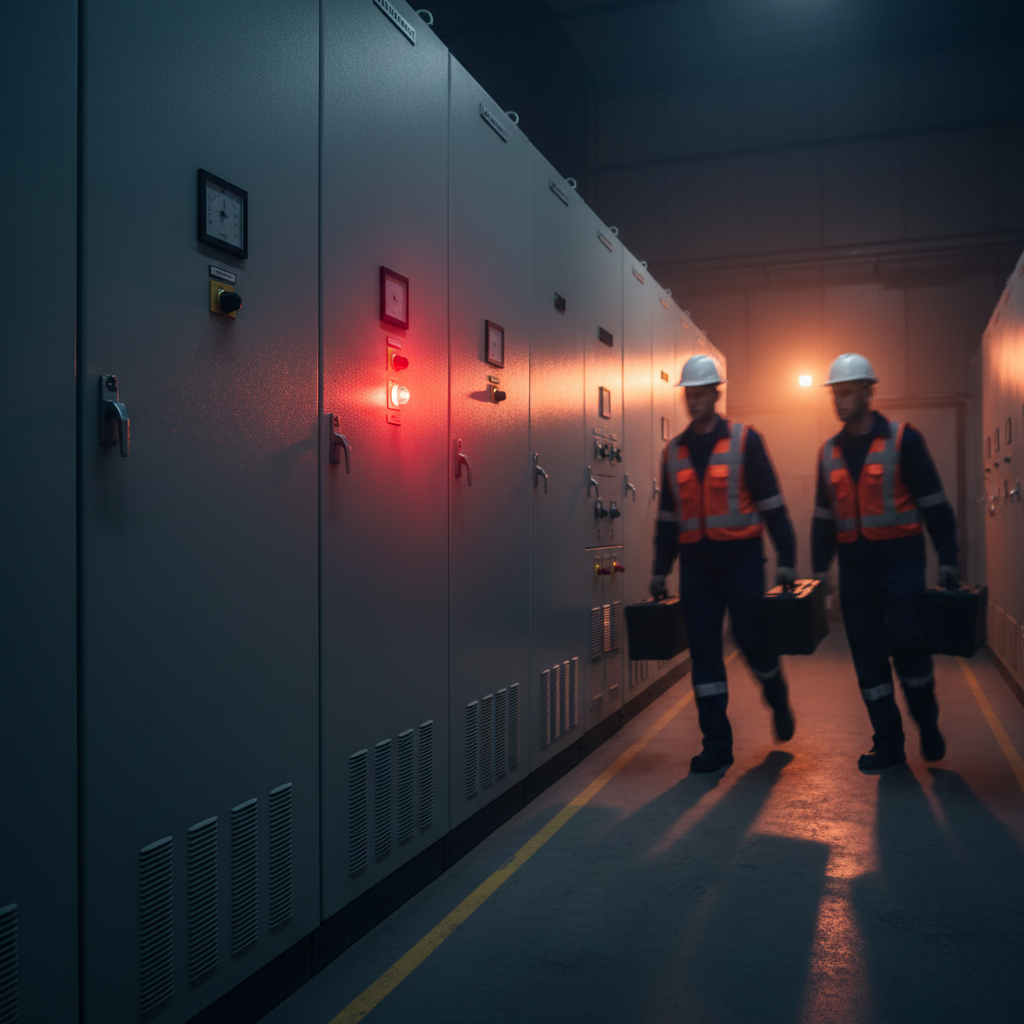
An unexpected power outage at your facility demands immediate and decisive action. The crucial first hour after an electrical emergency can significantly impact safety, equipment, and the duration of downtime. This guide provides facility managers and plant engineers with a structured approach to initial response, focusing on personnel safety, system isolation, and effective communication.
Prioritize Safety: People Before Power
The absolute first priority in any electrical emergency is the safety of personnel. This means ensuring everyone is accounted for and moved away from immediate hazards. Even if the power is out, residual energy, stored energy in capacitors, or the potential for a sudden re-energization poses significant risks. Referencing NFPA 70E, Standard for Electrical Safety in the Workplace, maintaining an electrically safe work condition is paramount, even in an emergency scenario.
- Account for Personnel: Immediately initiate a head count and ensure all employees, contractors, and visitors are safe and clear of affected areas. Establish a designated muster point if not already done.
- Assess Immediate Hazards: Look for obvious dangers such as fallen conductors, arcing equipment, smoke, fire, or damaged infrastructure. Do not approach or attempt to interact with damaged electrical equipment.
- Implement Emergency Lighting: Ensure emergency lighting systems are functional to aid evacuation and safe movement within the facility.
Isolate the Source: Preventing Further Damage and Injury
Once personnel safety is addressed, the next critical step is to isolate the electrical fault. This prevents further damage to equipment, reduces the risk of arc flash or shock hazards during troubleshooting, and sets the stage for a safe restoration process. This involves de-energizing affected circuits and equipment.
Local Disconnection vs. Main Disconnect
The extent of the isolation depends on the nature and location of the outage. For a localized fault (e.g., a single circuit breaker trip), local disengagement may suffice. However, for widespread outages or unknown causes, de-energizing the main service entrance may be necessary.
| Action | Description | Considerations |
|---|---|---|
| Local Disconnection | For clearly identified, localized faults, operate the specific circuit breaker or switch that controls the affected equipment. | Requires knowledge of the electrical distribution system and the ability to safely access switchgear. |
| Main Disconnection | For widespread outages, unknown causes, or when a localized disconnection is not feasible or safe, operate the main service disconnect switch or circuit breaker. This de-energizes the entire facility's internal electrical distribution, ensuring no power enters the building from the utility side. | Typically requires specialized training and PPE (NFPA 70E compliance). Consult local AHJ requirements. |
Regardless of the method, proper lockout/tagout (LOTO) procedures, as outlined in NFPA 70E, must be initiated immediately after de-energization to prevent accidental re-energization. This ensures that electrical equipment cannot be unexpectedly started up while personnel are working on it or investigating the issue.
- Verify Zero Electrical Potential: Before any work begins, always verify the absence of voltage using an adequately rated and tested voltage detector. NETA MTS, Standard for Maintenance Testing Specifications for Electrical Power Equipment and Systems, emphasizes the importance of proper testing procedures for electrical equipment.
- Implement LOTO: Apply lockout/tagout devices to all sources of energy for the affected equipment. This physically secures the isolating devices in the OFF position.
Assess and Communicate: The Crucial Next Steps
With safety and isolation addressed, the next phase involves assessing the situation and communicating effectively with internal stakeholders and external service providers.
Internal Communication
- Facility Management: Notify relevant departments of the outage, its suspected scope, and anticipated downtime. This includes production, IT, security, and human resources.
- Maintenance/Engineering Teams: Mobilize your internal electrical maintenance staff (if applicable) to begin preliminary assessment of the damage, always adhering to safety protocols (e.g., arc-flash PPE per NFPA 70E).
External Communication
- Utility Provider: Contact your local electrical utility company to determine if the outage is external (grid issue) or internal to your facility. Provide them with as much detail as possible.
- Emergency Service Provider: For complex internal faults, engage a qualified emergency electrical service contractor. Having a pre-established relationship with a reliable contractor like AK&J Electric can significantly reduce response times. Be prepared to provide details such as:
- Nature of the incident (e.g., smoke, loud noise, equipment failure)
- Scope of the outage (e.g., entire facility, specific area)
- Any initial observations or actions taken
- Location and accessibility of the affected equipment
Document Everything
Maintain a detailed log of events, observations, actions taken, and communications. This documentation is invaluable for post-incident analysis, insurance claims, and future emergency planning.
Bottom Line
The first hour after an electrical outage is a critical window for mitigating risks and setting the stage for efficient restoration. Prioritizing personnel safety, systematically isolating the affected systems, and establishing clear communication channels are paramount. While internal teams can handle initial safety measures, complex electrical emergencies often require specialized expertise. AK&J Electric offers 24/7 emergency electrical service, providing the skilled technicians and equipment necessary to diagnose and repair critical electrical infrastructure safely and efficiently.