Navigating the world of industrial control systems often brings facility managers and plant engineers to a pivotal question: should we opt for a Programmable Logic Controller (PLC)-based system or a traditional hardwired control panel? The answer significantly impacts initial cost, operational flexibility, and future scalability. Understanding the strengths and weaknesses of each approach is crucial for making an informed decision that aligns with operational demands and budgetary constraints.
Understanding Hardwired Control Panels
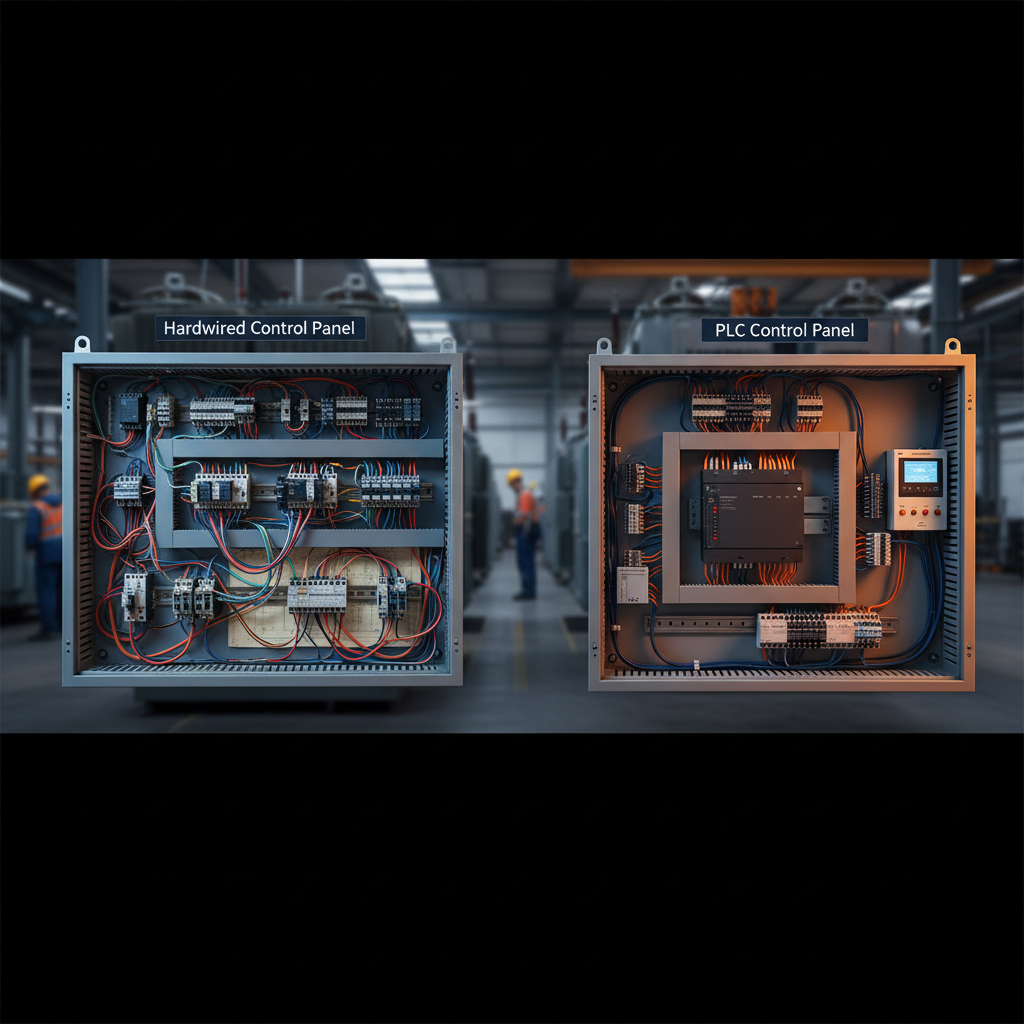
Hardwired control panels, often considered the legacy approach, rely on physical relays, timers, and other discrete components interconnected with individual wires to execute a specific control sequence. Each function, once designed, is permanently wired into the panel. Modifications necessitate physical rewiring, which can be labor-intensive and costly.
Advantages of Hardwired Control Panels:
- Simplicity for Small, Fixed Applications: For very simple, unchanging control tasks, a hardwired panel can be more straightforward to design and build. Think of basic motor start-stop stations or fixed-sequence operations where changes are highly improbable.
- Lower Initial Cost (for simple systems): In minimalist applications, the component cost and engineering time can sometimes be less than that of a PLC system.
- Durability and Reliability: With fewer complex electronic components, hardwired systems can be robust in harsh environments, provided they are properly maintained and protected (refer to NEMA enclosure ratings).
Disadvantages of Hardwired Control Panels:
- Inflexibility and High Modification Costs: Any change in control logic requires physical rewiring, leading to increased downtime and labor costs. This is a significant drawback in dynamic industrial environments.
- Troubleshooting Complexity: Diagnosing issues in complex hardwired panels can be time-consuming due to the sheer volume of wiring and discrete components.
- Limited Diagnostics and Data: Hardwired systems offer minimal diagnostic capabilities and typically do not provide operational data for analysis or integration with higher-level systems.
- Space Requirements: As complexity increases, hardwired panels can become very large, consuming valuable floor space.
Understanding PLC-Based Control Panels
PLC-based control panels utilize a programmable microprocessor to execute control logic. Instead of physical wiring for each control function, the logic is programmed into the PLC. This software-centric approach offers unparalleled flexibility and advanced capabilities.
Advantages of PLC-Based Control Panels:
- Flexibility and Ease of Modification: Control logic can be easily changed, modified, or expanded through software updates rather than physical rewiring. This is invaluable for processes that evolve or require frequent adjustments.
- Advanced Diagnostics and Troubleshooting: PLCs offer built-in diagnostic tools, error codes, and remote access capabilities, significantly reducing troubleshooting time and improving system uptime.
- Integration with SCADA/HMI: PLCs seamlessly integrate with Supervisory Control and Data Acquisition (SCADA) systems and Human-Machine Interfaces (HMIs), providing real-time data, trend analysis, and centralized control. This aligns with modern Industry 4.0 initiatives.
- Scalability: Adding new functions or expanding the system becomes much easier with a PLC. Simply update the program and potentially add I/O modules.
- Reduced Wiring and Panel Space: While the PLC itself has wiring, the overall complexity of point-to-point wiring for control logic is greatly reduced, often leading to smaller physical footprint requirements. This can help adhere to requirements like those found in NFPA 79, "Electrical Standard for Industrial Machinery," which advocates for clear and organized wiring.
Disadvantages of PLC-Based Control Panels:
- Higher Initial Cost (for simple systems): The cost of the PLC hardware and software licensing can make the initial investment higher for very basic applications.
- Programming Expertise Required: While user-friendly software exists, programming and maintaining PLCs requires specialized knowledge and training.
- Cybersecurity Considerations: As networked devices, PLCs introduce cybersecurity vulnerabilities that must be addressed through robust network architecture and security protocols (refer to IEC 62443 series for industrial cybersecurity standards).
Decision Matrix: PLC vs. Hardwired
| Feature/Consideration | Hardwired | PLC-Based |
|---|---|---|
| Application Complexity | Low (fixed sequence, discrete functions) | Medium to High (dynamic, complex logic) |
| Future Modifications | Difficult, costly (rewiring) | Easy (software changes), lower cost |
| Diagnostics | Manual, time-consuming | Advanced, built-in, often remote |
| Data Logging/SCADA | Limited/None | Excellent, seamless integration |
| Initial Cost | Lower (simple systems) | Higher (simple systems, but scales better) |
| Space Requirements | Increases with complexity | More compact for complex logic |
| Expertise Required | Basic electrical | Programming, networking, advanced electrical |
| Long-Term Cost | Higher (maintenance, modifications) | Lower (maintenance, flexibility, data insights) |
Integration Costs and Scalability
When evaluating systems, consider the total cost of ownership, not just the upfront hardware expenses. Integration costs for hardwired systems can skyrocket when modifications are needed or when trying to interface with other systems. Each change in logic requires physical labor, downtime, and extensive testing, which quickly erodes any initial cost savings. Furthermore, hardwired systems offer very limited scalability; expanding functionality often necessitates entirely new panels or significant overhauls.
Conversely, PLCs excel in integration and scalability. Their software-defined nature allows for relatively straightforward modifications, additions of I/O, and seamless communication with other industrial control devices and enterprise systems. This means that as your facility's needs evolve or expand, a PLC-based system can adapt more readily, protecting your initial investment and reducing future upgrade costs. The ability to integrate with SCADA and HMI platforms provides a comprehensive view of operations, enabling data-driven decision-making and predictive maintenance strategies, a key aspect supported by standards like NETA MTS (Maintenance Testing Specifications) which emphasizes continuous monitoring and data analysis.
The Bottom Line
While hardwired control panels retain a niche for truly static, simple applications, the overwhelming advantages of PLC-based systems in terms of flexibility, diagnostics, integration, and scalability make them the preferred choice for most modern industrial and commercial control endeavors. The higher initial investment in a PLC system is frequently offset by significant long-term savings in operational efficiency, reduced downtime, and adaptability to future requirements. For expert guidance on designing, installing, or upgrading your control panels to meet specific operational needs and ensure compliance with standards like NEC 2023 and NFPA 70E for electrical safety, consider consulting with experienced electrical contractors and switchgear manufacturers. AK&J Electric offers comprehensive services in control system design, integration, and field support.", read_minutes=6.0, cover_prompt=