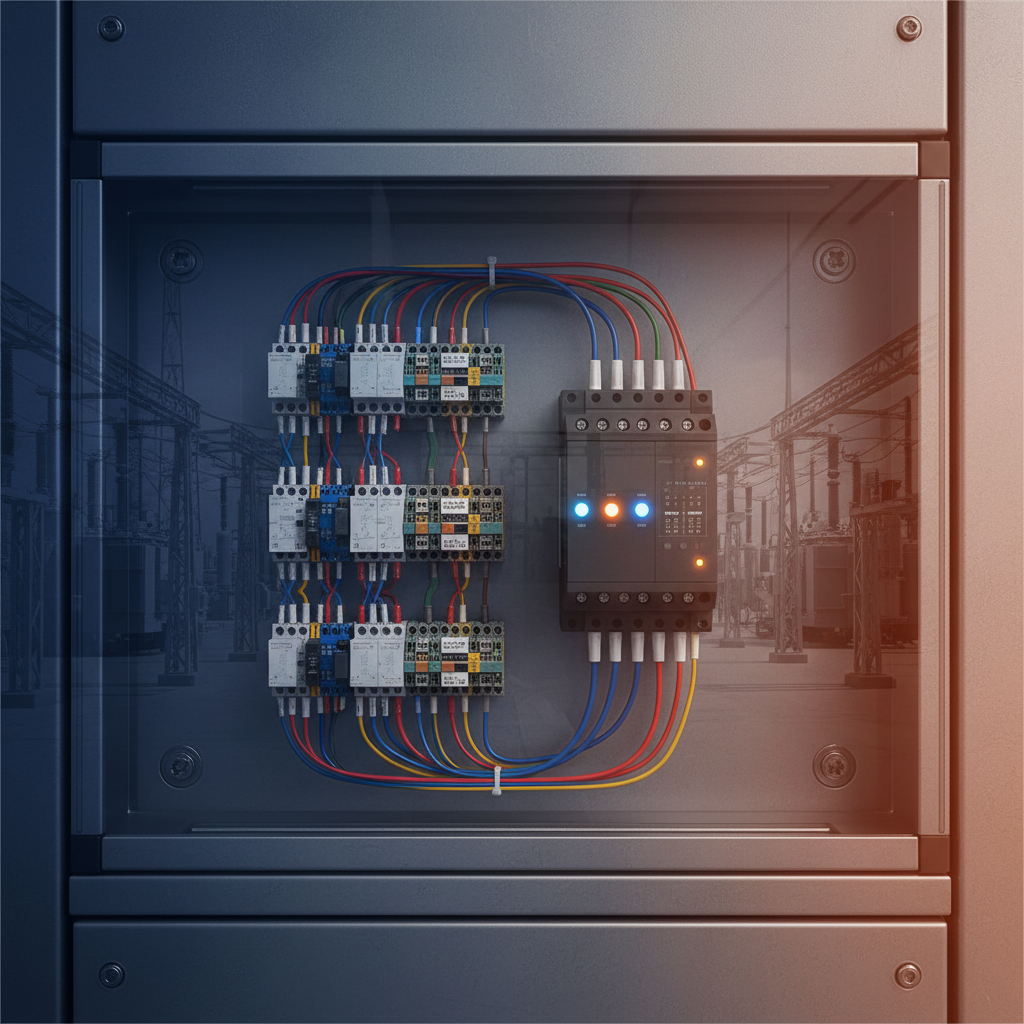
The heart of any industrial operation lies in its control system. When designing or upgrading these systems, a fundamental choice emerges: whether to implement a Programmable Logic Controller (PLC) based panel or a traditional hardwired approach. This decision profoundly impacts initial investment, operational flexibility, maintenance, and future scalability.
Understanding Hardwired Control Panels
Hardwired control panels, often seen in legacy systems and simpler applications, rely on direct physical wiring between components. Each control function—like starting a motor or indicating a fault—requires dedicated wiring from the input device (e.g., a push button) to the control relay and then to the output device (e.g., a motor starter). Logic is implemented through the physical interconnection of relays, timers, and other electro-mechanical devices.
Advantages:
- Simplicity for Small Systems: For very basic, standalone operations with few interlocks, hardwiring can be straightforward.
- Predictable Operation: The direct nature of hardwiring means predictable behavior that's easy to troubleshoot with an electrical schematic and multimeter.
- Lower Initial Cost (for very small systems): For highly localized and simple control logic, the component cost might be lower upfront than a PLC system.
- Immunity to Software Glitches: No software means no software bugs or cybersecurity vulnerabilities inherent to programming.
Disadvantages:
- Inflexibility: Modifying logic requires physical rewiring, which is time-consuming, expensive, and increases the risk of errors. Even minor changes can lead to significant downtime.
- High Debugging Time for Complex Systems: As logic complexity grows, troubleshooting hardwired systems becomes exponentially more difficult and time-consuming.
- Space Requirements: Relay-based logic can consume considerable panel space, especially in complex systems.
- Limited Diagnostics: Diagnostic capabilities are typically basic, often relying on indicator lights.
Understanding PLC-Based Control Panels
PLC-based control panels centralize control logic within a programmable microprocessor. Instead of discrete relays for every function, inputs (e.g., sensors, push buttons) and outputs (e.g., motor starters, indicator lights) are wired to I/O modules, which then communicate with the PLC. The control logic is written in software and downloaded to the PLC.
Advantages:
- Flexibility and Ease of Modification: Logic changes are software-based, allowing for rapid modifications, additions, and optimization without physical rewiring. This is invaluable during commissioning and for future process improvements.
- Advanced Diagnostics: PLCs offer extensive diagnostic features, often with built-in fault identification, historical data logging, and communication capabilities to HMIs (Human-Machine Interfaces) or SCADA systems. This reduces downtime and speeds up troubleshooting, aligning with NETA\'s emphasis on efficient commissioning and maintenance.
- Scalability: Expanding control systems is simpler; new I/O modules can be added, and programming updated to accommodate new equipment or processes.
- Reduced Panel Space: PLCs and their I/O modules typically occupy less panel space than an equivalent relay-based system, especially for complex logic.
- Integration with Other Systems: PLCs readily integrate with higher-level control systems (SCADA, MES) and communicate over industrial networks (Ethernet/IP, Modbus TCP, Profinet, etc.), enabling data analytics and remote monitoring.
- Standard Compliance: Modern PLC systems often simplify compliance with standards like NFPA 79 (Industrial Machinery Electrical Standard) due to their organized structure and robust diagnostics.
Disadvantages:
- Higher Initial Cost (for simple systems): The cost of the PLC hardware and programming software can be a barrier for very small, simple control needs.
- Programming Expertise Required: An understanding of PLC programming languages (e.g., ladder logic, structured text) is necessary for setup and modification.
- Cybersecurity Considerations: As networked devices, PLCs require attention to cybersecurity best practices, adhering to guidelines often outlined by organizations like NIST.
When Each Wins: A Decision Matrix
Choosing between PLC and hardwired depends heavily on the specific application. Here