When designing or upgrading industrial control systems, facility managers and plant engineers often face a fundamental choice: implement Programmable Logic Controllers (PLCs) or opt for traditional hardwired panels. Both approaches offer distinct advantages and disadvantages, impacting initial costs, operational flexibility, maintenance, and future scalability. Understanding these differences is crucial for selecting the most appropriate and cost-effective solution for your specific application.
The Hardwired Control Panel: Reliability Through Simplicity
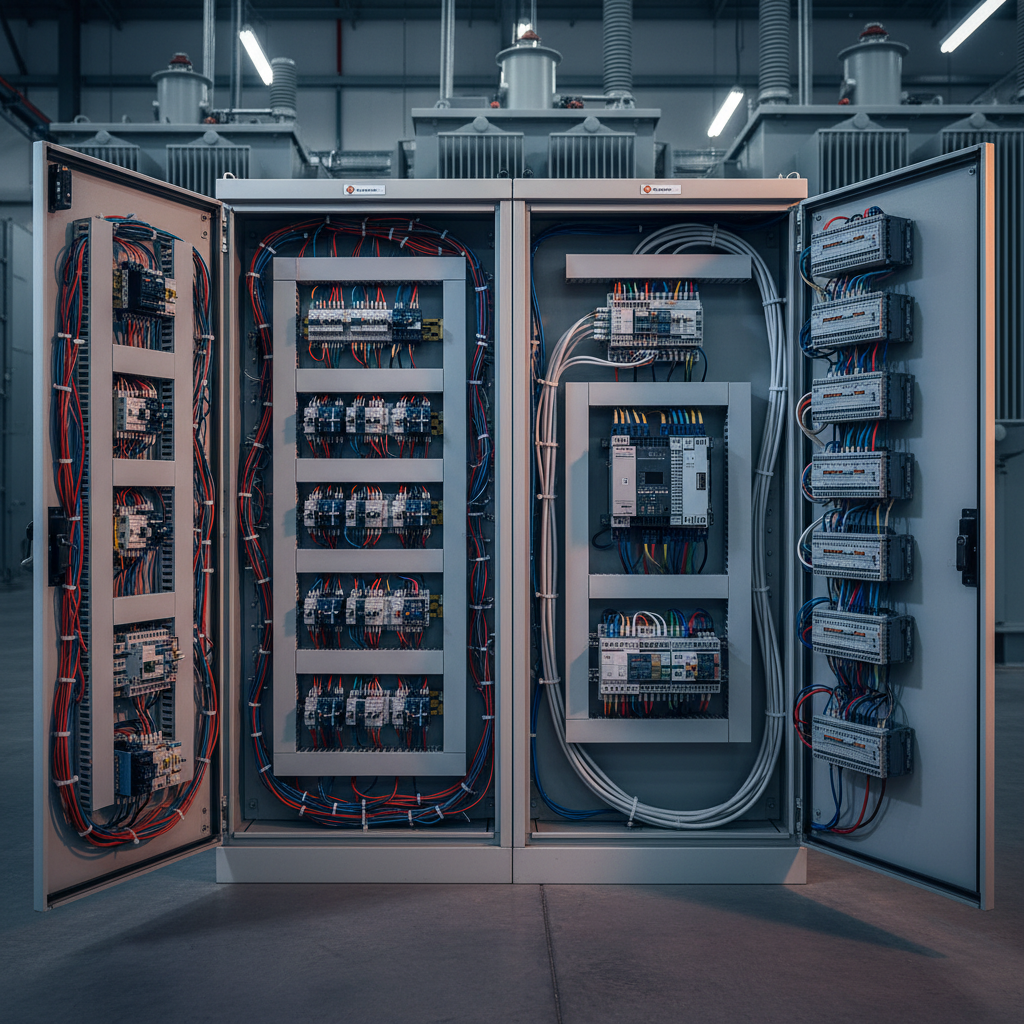
Hardwired control panels utilize discrete components such as relays, timers, contactors, and pushbuttons, all interconnected via physical wiring to achieve desired control logic. Each function, sequence, or interlock is directly wired, making the system transparent and easy to troubleshoot for those familiar with electrical schematics.
Advantages of Hardwired Panels:
- Simplicity and Predictability: The logic is physically observable. For small, fixed-function applications, this direct relationship can simplify troubleshooting.
- Lower Initial Cost for Simple Systems: For very basic control tasks with limited I/O (Input/Output) and no anticipated changes, hardwired solutions can be more economical upfront.
- Robustness: With fewer electronic components, hardwired systems can sometimes be less susceptible to electrical noise and transient interference, though proper grounding and shielding are critical for all systems (refer to NEC 2023, Article 250).
- No Programming Required: Eliminates the need for specialized programming knowledge or software.
Disadvantages of Hardwired Panels:
- Inflexibility: Modifying logic requires physical rewiring, which is time-consuming, expensive, and introduces potential for wiring errors. This impacts long-term integration costs.
- Higher Costs for Complex Systems: As system complexity and I/O count increase, the sheer volume of wiring and components drives up material and labor costs significantly.
- Maintenance Challenges: While straightforward in principle, complex hardwired panels can have dense wiring, making fault isolation difficult.
- Limited Diagnostics: Advanced diagnostics are generally not available without adding separate monitoring equipment.
- Scaling Limitations: Expanding functionality or adding new processes typically means substantial rework or entirely new panels.
The PLC Control Panel: Flexibility and Intelligence
Programmable Logic Controllers (PLCs) are industrial computers that monitor inputs and make decisions based on a programmed logic to control outputs. They have become the backbone of modern automation, offering unparalleled flexibility and advanced capabilities.
Advantages of PLC Panels:
- Flexibility and Ease of Modification: Logic changes are made through software, allowing for rapid adjustments, process optimizations, and integration of new features without physical rewiring. This significantly reduces long-term integration costs.
- Advanced Diagnostics and Troubleshooting: PLCs offer built-in diagnostic tools, fault logging, and communication capabilities that speed up troubleshooting and minimize downtime. Many modern PLCs also support remote access for diagnostics.
- Scalability: PLCs can easily accommodate additional I/O modules, communication interfaces, and more complex control strategies as system requirements evolve.
- Integration Capabilities: PLCs readily integrate with Human-Machine Interfaces (HMIs), SCADA systems, and other industrial networks, enabling centralized control, data acquisition, and enterprise-level connectivity.
- Standardization: Using PLCs can lead to more standardized control architectures across a facility, simplifying maintenance and training.
- Reduced Panel Size: Often, a single PLC can replace a large number of discrete relays, reducing the physical footprint of the control panel.
Disadvantages of PLC Panels:
- Higher Initial Cost for Simple Systems: For very basic applications, the upfront cost of a PLC and its associated programming software can be higher than a simple hardwired solution.
- Programming Expertise Required: Implementing and modifying PLC logic requires specialized programming knowledge.
- Software Dependency: Requires software licenses and compatibility considerations for programming and configuration.
- Cybersecurity Considerations: As network-connected devices, PLCs introduce cybersecurity risks that must be managed, adhering to best practices and industry guidelines.
Decision Matrix: PLC vs. Hardwired
To help guide your decision, consider the following factors:
| Feature | Hardwired Control Panel | PLC Control Panel |
|---|---|---|
| Application Complexity | Low to Moderate | Moderate to High |
| Expected Changes | Minimal to None | Frequent / Likely |
| I/O Count | Low (typically < 20-30 points) | Low to Very High (hundreds/thousands) |
| Diagnostics | Basic (visual inspection) | Advanced (software-based, remote) |
| Integration Needs | Standalone, isolated | Networked, SCADA, HMI integration |
| Scalability | Limited; significant rework for expansion | High; modular expansion |
| Panel Size | Increases with complexity | Can be compact; independent of logic complexity |
| Maintenance Skills | Electrical wiring, component replacement | Electrical, programming, network troubleshooting |
| Arc Flash Hazard | Both require arc flash analysis (NFPA 70E) | Both require arc flash analysis (NFPA 70E) |
Considerations for Integration Cost and Scaling
When evaluating total cost of ownership, look beyond the initial purchase price. Hardwired systems, while potentially cheaper upfront for very simple tasks, incur significant costs during modifications or expansions. Each change means labor-intensive rewiring, new schematics, and potentially prolonged downtime. This directly impacts overall integration costs.
PLCs, conversely, offer substantial savings in these areas. Once the initial investment in hardware and programming expertise is made, modifying logic or adding new functionalities is primarily a software task. This dramatically reduces downtime and labor costs for integration and scaling. For operations that anticipate growth, process changes, or require future connectivity to enterprise systems, the scalability of a PLC system nearly always outweighs the initial cost difference.
Regardless of the chosen control method, adhering to recognized standards is paramount. All electrical installations, including control panels, must comply with NFPA 70 (National Electrical Code - NEC 2023) for safe installation. Additionally, NFPA 70E (Standard for Electrical Safety in the Workplace) dictates requirements for safe work practices around electrical equipment, including control panels, addressing arc flash and shock hazards. For testing and maintenance, NETA MTS (Maintenance Testing Specifications) provides guidelines for ensuring the operational integrity of electrical systems and components, crucial for both hardwired and PLC-based panels.
Bottom Line
The choice between PLC and hardwired control panels hinges on a comprehensive assessment of application complexity, anticipated changes, integration requirements, and long-term scalability. While hardwired systems offer straightforward reliability for static, simple tasks, modern industrial demands for flexibility, advanced diagnostics, and seamless integration overwhelmingly favor PLC-based solutions. Considering total lifecycle costs, including future modifications and maintenance, often reveals PLCs as the more economical and future-proof choice for most applications. AK&J Electric provides expert design, installation, and field services for both hardwired and PLC-based control systems, ensuring optimal performance and safety for your facility.